

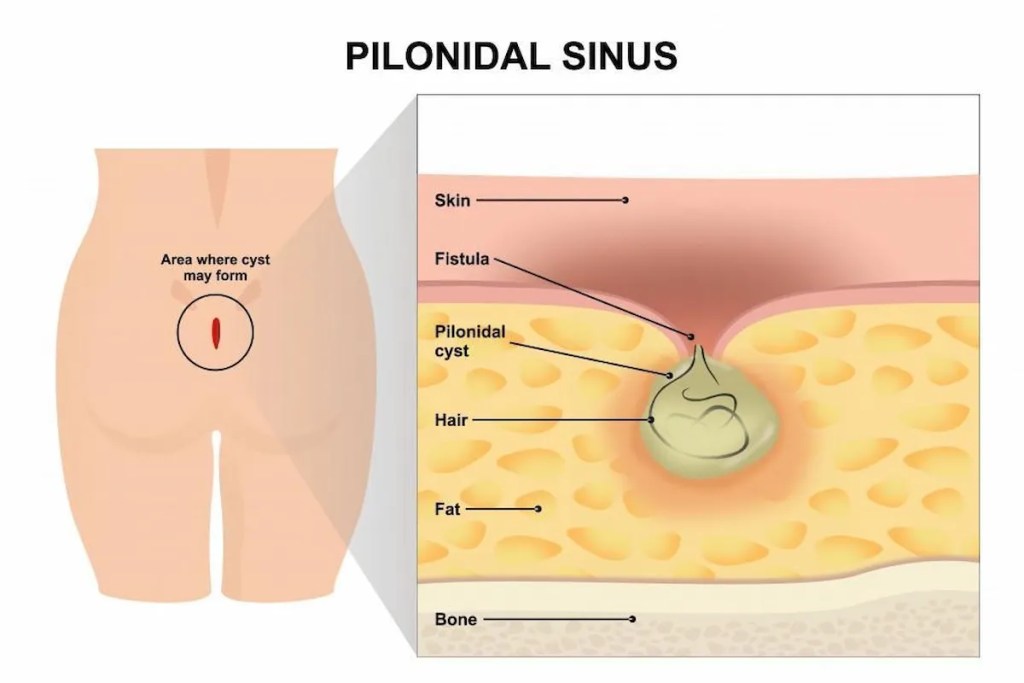
The area that a pilonidal cyst affects can be confusing to make sense of.
If you’ve recently noticed a painful lump near your tailbone, or you’ve been dealing with one that keeps coming back, you’re probably trying to work out exactly what’s happening down there. You’re not alone in that.
Pilonidal cysts are far more common than most people realize, and the embarrassment around their location is one of the biggest reasons people put off getting help.
Below you will find a clear explanation on where these cysts actually form, why this specific part of your body is so prone to them, and what the affected area can tell you about how serious things are.
Where Pilonidal Cysts Actually Form
Pilonidal cysts develop in one very specific spot, natal cleft, the small crease that runs between your buttocks just above the tailbone (the coccyx).
Most form in the upper portion of that cleft, usually one to two inches above the anus. The exact spot shifts a little from person to person depending on body shape, how deep the cleft is, and where hair growth is heaviest. Sometimes the cyst sits higher up near the sacrum. Other times it extends lower and feels uncomfortably close to the anus. The source of the problem is the same either way.
The word “pilonidal” comes from Latin: pilus (hair) and nidus (nest), which is more or less what’s going on under the skin. A small pocket forms beneath the surface, and hair, dead skin cells, and bacteria get trapped inside it. Your body treats that debris as a threat, and inflammation follows.

Why This Specific Area Is So Vulnerable
The natal cleft is, biologically speaking, about the worst possible spot on your body for keeping things calm and dry. A few factors stack up to make it uniquely prone to cysts and infections.
Constant pressure and friction is the first. Every time you sit, the skin and hair in this area get pushed and pulled, and over time that friction can drive loose hairs into the skin.
Then there’s warmth and moisture. The natal cleft traps sweat and stays warmer than the rest of your skin, and bacteria do well in those conditions.
Body hair matters too. Thicker, coarser hair in the lower back and buttocks raises the risk a lot, and the more hair there is, the higher the chance of one becoming ingrown.
Finally, some people simply have a naturally deeper cleft, which makes hair and debris harder to clear and easier to trap.
This is also why men are affected more often than women. They tend to have more body hair, a deeper cleft, and statistically more time spent sitting in driving or desk jobs. According to the Cleveland Clinic, more than 70,000 cases are reported in the US every year, and the real number is almost certainly higher because so many people never seek treatment out of embarrassment.
One thing that’s worth emphasizing clearly is that a pilonidal cyst is not a hygiene problem. People who shower twice a day still get them. The cause is mechanical, down to friction, hair, and anatomy, not how clean you are.
What the Affected Area Looks and Feels Like
How a pilonidal cyst presents depends on its stage. Early on, you might notice a small, firm bump just above the tailbone, mild tenderness when you sit for long stretches, and maybe a slight dimple, pit, or even a visible hair poking out of the skin.
Once the cyst becomes infected (which it eventually does in most cases), the affected area behaves very differently. The lump grows larger and feels hot to the touch. The skin turns red and looks irritated. The pain gets sharp, especially when you sit. A foul-smelling drainage often follows, and in serious cases you may even run a fever and get chills.
Those drainage points are called sinus tracts, tiny tunnels that form between the cyst and the surface of the skin. A lot of people have more than one, which is why the condition often gets called “pilonidal sinus disease” rather than being described as a single cyst.

When the Cyst Sits Close to the Anus
This is one of the things that worries people the most, and it’s one of the most stressful parts of the condition. A pilonidal cyst can extend down the natal cleft to a point where it feels worryingly close to the anus. That does not mean the cyst is in or affecting the anus itself. They’re two completely separate structures.
That said, if you have drainage, severe pain, or symptoms that seem to come from inside the rectum rather than the surface skin, get it looked at. Conditions like perianal abscesses or anal fistulas can present in a similar way and need very different treatment. If you’re not sure which one you’re dealing with, our guide on telling a perianal abscess apart from a pilonidal cyst breaks down the differences.
How the Affected Area Can Spread Over Time
Untreated pilonidal cysts rarely stay small and contained. Over months and years, the affected area can expand in three ways:
- New sinus tracts branch out from the original cyst, often creating multiple openings along the cleft.
- The cavity enlarges, especially after repeated infections, since each flare-up leaves more scar tissue and a larger pocket beneath the skin.
- Recurrence after treatment. Even after surgery, recurrence rates can reach as high as 40%, particularly with traditional excision.
This is why ignoring the cyst rarely works out as a long-term plan. The earlier the affected area is dealt with, the smaller and simpler the eventual treatment tends to be. If yours is already flaring, our guide to pilonidal cyst treatments covers every option from home care to surgery.
Frequently Asked Questions
Where do pilonidal cysts usually form?
In the natal cleft, the crease between the buttocks, typically one to two inches above the anus and just below the tailbone. The exact position varies with body shape and cleft depth, but the upper part of the cleft is by far the most common spot.
Can a pilonidal cyst be near the anus?
It can sit low enough in the cleft to feel close to the anus, but a pilonidal cyst is a separate structure from the anus and rectum. If your symptoms seem to come from inside the rectum rather than the skin surface, that points to a different condition, like a perianal abscess or fistula, and is worth getting checked.
Can a pilonidal cyst become cancerous?
It’s extremely rare, but very long-standing, chronically infected pilonidal disease that has gone untreated for many years (often decades) carries a small risk of a skin cancer called squamous cell carcinoma developing in the affected area. This is uncommon and not something a recently diagnosed cyst should cause alarm about. It’s simply one more reason not to leave a chronic, recurring cyst unaddressed for years.
How big does the affected area get?
It depends entirely on how long the disease has been active. A new cyst may be the size of a pea. Long-standing disease with multiple sinus tracts can affect several inches of the cleft. Repeated infections enlarge the cavity over time, which is the main argument for treating it sooner rather than later.
The Bottom Line
The affected area is small, but its impact on daily life is not. Work, sleep, sitting, exercise, even travel all get harder when this part of your body isn’t cooperating. The upside is that understanding what’s happening, and where, is the first real step toward getting control of it.
If you want a complete, practical guide to managing pilonidal cyst pain at home, including the routines, products, and home-care strategies that actually work, download our free guide:
You Don’t Have to Get Cut Open: A Practical Guide to Managing Pilonidal Cysts at Home
Leave a Reply